
Insightful, but incomplete explanation of crime
Isn’t it a paradox that we are bombarded with crime in the news every single day, yet the question of why people actually commit crimes is hardly ever addressed?
Sure, there is an abundance of true crime, some of which at least give partial explanations, but there is no popular book that specifically addresses the question of why people commit crime or how we could reduce crime in society.
Do you know one?
Well the closest I could find to such a book is Tom Gash’s Criminal, which was published around ten years ago.
In it, Gash debunks 11 common misconceptions about crime, such as that crime is rising, that immigration causes crime, that major reforms are needed to address crime, but also that poverty is the real cause of crime.
A major contribution that blew my mind when I first read it (even though we see it every day) is that how people view crime essentially falls into two opposing camps, two differing narratives.
Firstly, there’s the “heroes and villains” narrative.
This is what we know from classic Hollywood films. The good guys and the bad guys.
Morality is black and white, and simple.
Criminals are bad people who make a free choice to commit horrible crimes; they are fundamentally different from us.
The focus is entirely on the individual, and society has no nothing to do with the choices that individuals make. Society is good, fair and needs to stay the way it is.
On the other side you have the “victims and survivors” view.
Audiences now like morally ambiguous shows such as The Wire or Breaking Bad.
Morality here is grey, and complex.
Criminals are the product of their upbringing, environment and due to societal pressures they often have no other choice than to commit crimes.
They are just like us.
The focus is on society, which cannot be entirely separated from the individual. Society is unfair to some and needs to be reformed.
Gash positions himself as neutral and points out the oversimplifications and mistakes that both sides tend to make using facts, statistics and case studies.
For example, the tabloid press likes to present the victims of violent crime as female and older (see photo), when in fact the most common victim of violent crime is a male teenager.
Equally, perpetrators and victims are always presented as mutually exclusive categories, when in fact perpetrators of crime are also the most likely victims.
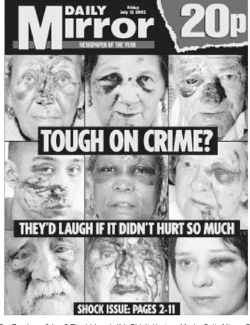
Victims of crime tend to be presented as old and female when in fact they are most likely to be male teenagers.
So by not agreeing with either side of the debate, where does Gash lead us?
What is his ultimate conclusion when it comes to the causes of crime?
This can be best illustrated with two examples.
One is motorcycle theft in Germany in the 1970s and 1980s.
Throughout the 1970s, motorcycle thefts in Germany were sky high, but then, from 1978 onwards, they suddenly started to fall with no apparent explanation.
Vehicle thefts remained high, but motorcycle thefts kept falling.
What was the reason?
Well, helmet-wearing for motorcyclists was made the law in 1978, which meant it had become less easy to just steal a motorcycle when you had the opportunity. It now involved more planning and more effort and as a result, it became less frequent.
This is the heart of Gash’s argument.
To him it is all about opportunity and availability; the ease with which a crime can be committed. (Today’s self-checkouts spring to mind.)
He believes that small interventions by the government, small nudges can have surprisingly large positive effects and that reducing crime therefore doesn’t always require major changes in society.
Such as when pubs introduced plastic glasses for their outdoor areas, instead of the heavy glass ones likely to cause injury. It massively reduced the number of late night injuries and hospital admissions after pub fights.
What he doesn’t try to explain, however, is how we could reduce the number of pub fights starting in the first place.
And this is the main shortfall of Gash’s book.
By narrowly focuses on crime opportunity for the individual, he disregards the root causes of crime in society.
Why do some societies have higher crime rates than others? It’s certainly not all due to interventions like swapping glass for plastic.
And this is where his refusal to take position on either of the two camps also falls short.
Yes, both the political left and the political right oversimplify and distort facts to match their world view.
However, we do have mountains of evidence that show reality to be much closer to the “victims and survivors” view than it is to the view that criminals are all bad people who make a free choice to commit crime.
Over 25% of prisoners are care leavers, compared to less than 1% of the wider population. 50% of prisoners are functionally illiterate. It would be absurd to suggest that this was their own making when they were small children.
Equally, we know drivers of crime in society. Societies that are more socioeconomically unequal have higher crime rates than more equal societies.
Government cuts can also increase crime: There is a strong correlation between youth centre closures and an increase in knife crime.
Gash ends his book by saying “The only obstacle to progress is in our heads; in our unwillingness to relinquish deeply cherished myths; in our reluctance to see the world as it really is.”
This is all true. We cannot make oversimplified generalisations just to fit our worldview.
But the world is also greater than the sum of its parts.
And if we only look at the parts, we won’t be able to find solutions that work for the whole, either.